Sampling
DevInterp uses Stochastic Gradient Langevin Dynamics (SGLD) to sample from the posterior distribution around model parameters. This is the foundation for computing Local Learning Coefficients (LLCs), Susceptibilities, and Bayesian Influence Functions (BIFs).
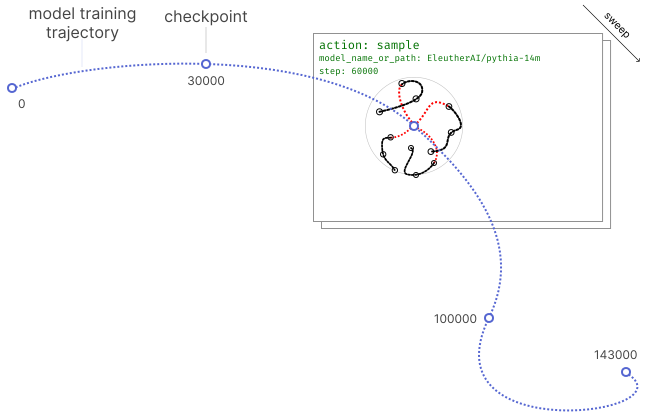
Sampling runs at a checkpoint along a model training trajectory. Training is separate from and precedes sampling.
How Sampling Works
The sample() function:
Runs multiple independent SGLD chains
At each draw, evaluates per-token loss on the sampling dataset and all observables
Writes everything to a Zarr store, returned as an
xr.DataTree
from devinterp.slt.sampling import sample

tree = sample(
    model=model,
    dataset=train_data,            # Used for SGLD gradients
    observables={
        "train": train_data,       # Evaluate loss on training data
        "code": (code_data, 5),    # (dataset, batches_per_draw)
    },
    lr=0.001,
    n_beta=30,
    num_chains=4,
    num_draws=200,
    batch_size=32,
)
Chains, Steps, and Draws
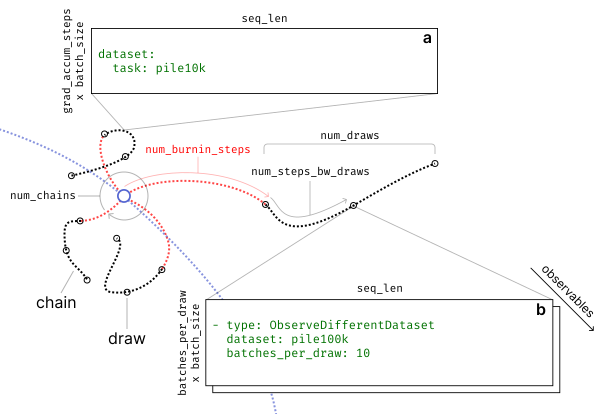
Each chain is an independent SGLD trajectory, initialized from the training checkpoint. Chains evolve through mini-batch gradients and injected Gaussian noise to explore the local loss landscape.
Within each chain:
Steps are individual SGLD updates that move through parameter space. Each step uses
gradient_accumulation_steps * batch_size * seq_lentokens per chain.Burn-in steps (
num_burnin_steps) are taken before the first draw to let the chain reach equilibrium.Draws occur every
num_steps_bw_drawssteps, where we compute observables.
The total number of SGLD steps per chain is:
num_burnin_steps + num_draws * num_steps_bw_draws.
For example, with num_burnin_steps=0 and num_steps_bw_draws=1:
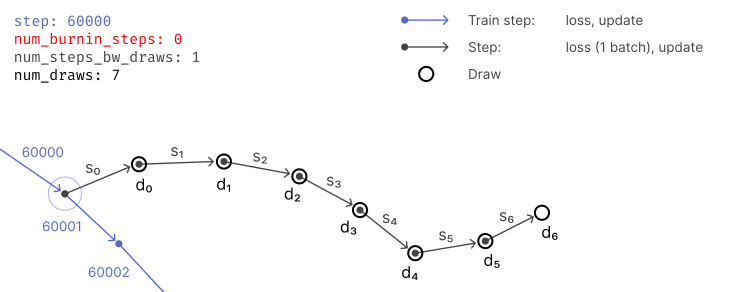
With one step between draws, observables are evaluated after every step.
With num_burnin_steps=3 and num_steps_bw_draws=3:
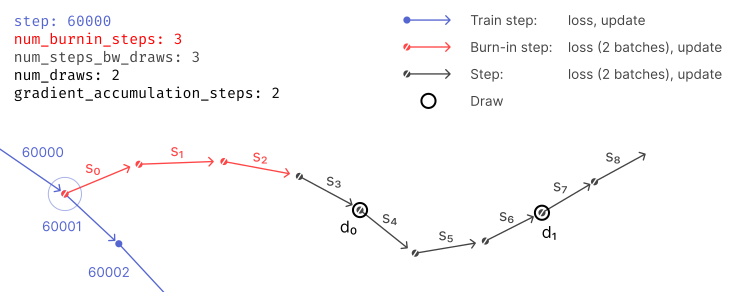
With three steps between draws, observables are evaluated after every third step. Burn-in steps delay the first draw.
Key Parameters
Sampling parameters:
lr: SGLD learning rate. Controls step size.n_beta: Inverse temperature. Higher values stay closer to the MAP estimate.num_chains: Number of independent chains. More chains give better statistics.num_draws: Number of draws per chain. More draws give more samples.num_burnin_steps: Steps before first draw. Allows the chain to reach equilibrium.num_steps_bw_draws: Steps between draws. Reduces autocorrelation between samples.batch_size: Batch size for SGLD gradient computation.
Observable parameters:
observables: Dict mapping names to datasets (or(dataset, batches_per_draw)tuples). Each observable is evaluated at every draw.batches_per_draw: Default number of batches per observable evaluation (default: 3).
Optimizer hyperparameters:
sampling_method: Which SGLD variant to use."sgmcmc_sgld"(default) is plain SGLD with a localization term;"rmsprop_sgld"adds RMSprop-style preconditioning.sampling_method_kwargs: Extra kwargs forwarded to the chosen method (e.g. rmsprop’salpha/eps/add_grad_correction).rmsprop_eps/rmsprop_alpha: Convenience aliases for the two most common rmsprop knobs; only valid whensampling_method='rmsprop_sgld'. Equivalent tosampling_method_kwargs={"eps": ..., "alpha": ...}.localization: Strength \(\gamma\) of the pull toward initial parameters (Lau et al. 2023).0disables.noise_level: SGLD noise std \(\sigma\). Default1.0; changing this breaks the posterior-sampling guarantee.llc_weight_decay: L2 regularization \(\lambda\), applied as a Gaussian prior centered at zero.bounding_box_size: If set, restricts sampling to a box of this radius around the initial parameters.Nonedisables.init_noise: If set, add Gaussian noise with this std to parameters once before sampling starts.
Weight restrictions:
param_masks: Dict mapping parameter names to mask tensors (orNonefor unrestricted). Only parameters in the dict are optimized; all others are frozen.
Output Format
sample() returns an xr.DataTree backed by Zarr containing:
init_loss(chain, token_pos): Initial loss before samplingsampling_loss(chain, draw, batch, token_pos): Per-token loss at each drawloss_{obs}(chain, draw, batch_{obs}, token_pos): Per-token observable lossesinput_ids_{obs}(batch_{obs}, token): Fixed input IDs for each observablen_beta: Scalar inverse temperaturemetrics_*(chain, step): SGLD diagnostics (whensave_metrics=True)
This DataTree is the input to post-processing functions like compute_llc(),
compute_bif(), and compute_susceptibilities().